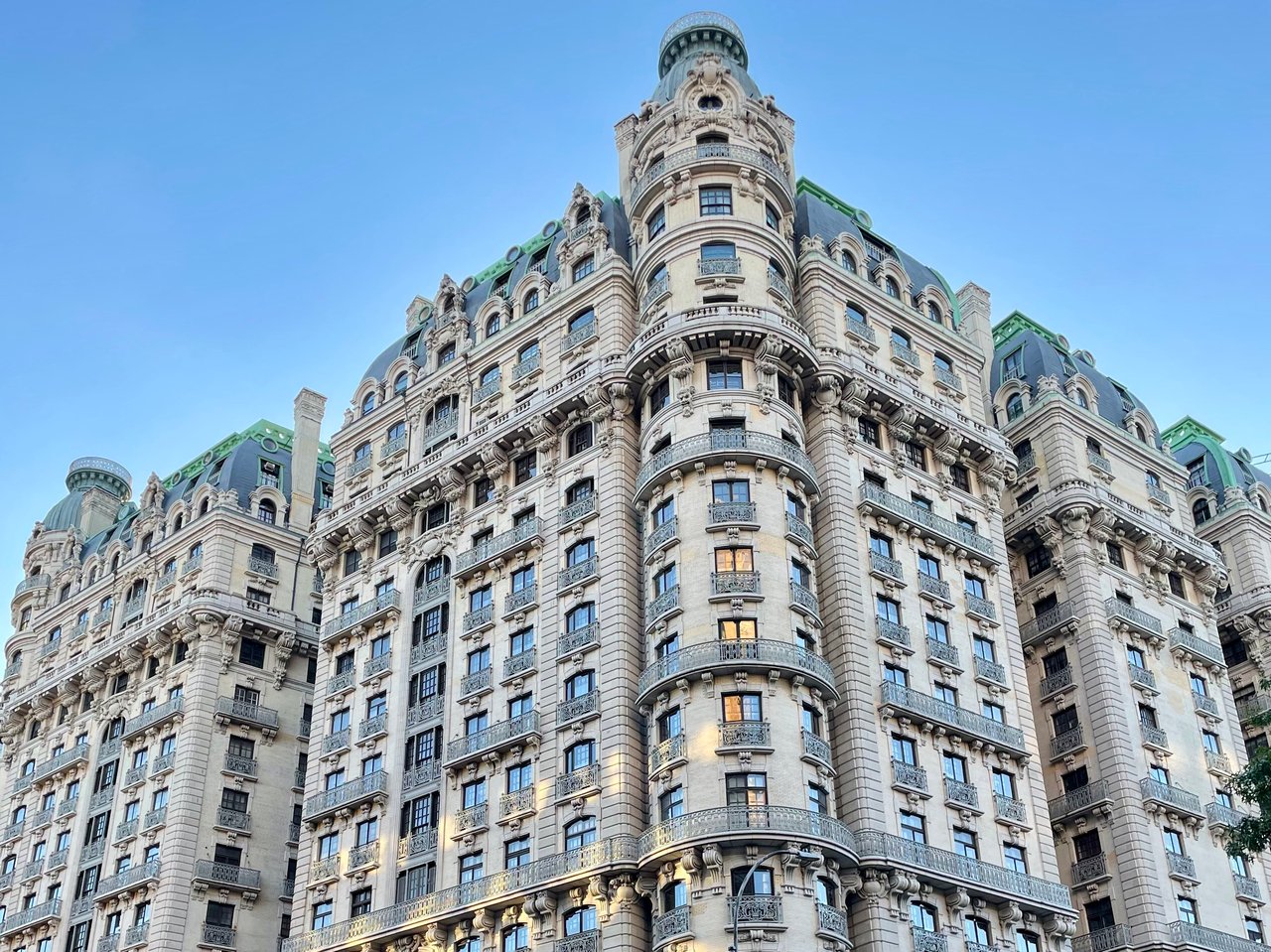
I've lived at the Ansonia since 2016, and I still find myself looking up at it in awe. I'm hardly alone. People walking along Broadway regularly stop to admire the building, craning their necks to take in its elaborate facade, mansard roof, turrets, and extraordinary roofline. Broadway curves as it approaches West 73rd Street, creating dramatic views of the building from several directions. Depending on where you're standing, the Ansonia seems to reveal an entirely different side of itself. From certain angles, it looks like a castle that somehow found its way into the middle of Manhattan.
New York is full of remarkable architecture, but few buildings command attention quite like the Ansonia. A decade after moving in, I haven't grown tired of looking at it.
Falling for the Ansonia
Before moving uptown, my wife and I were living at a new construction apartment building in Hell's Kitchen. It had just about everything you'd expect from a modern luxury rental: a roof deck, gym, common spaces, and a 24-hour doorman, among other amenities. We'd made wonderful friends there, but we were ready for more space and a neighborhood with a little more character.
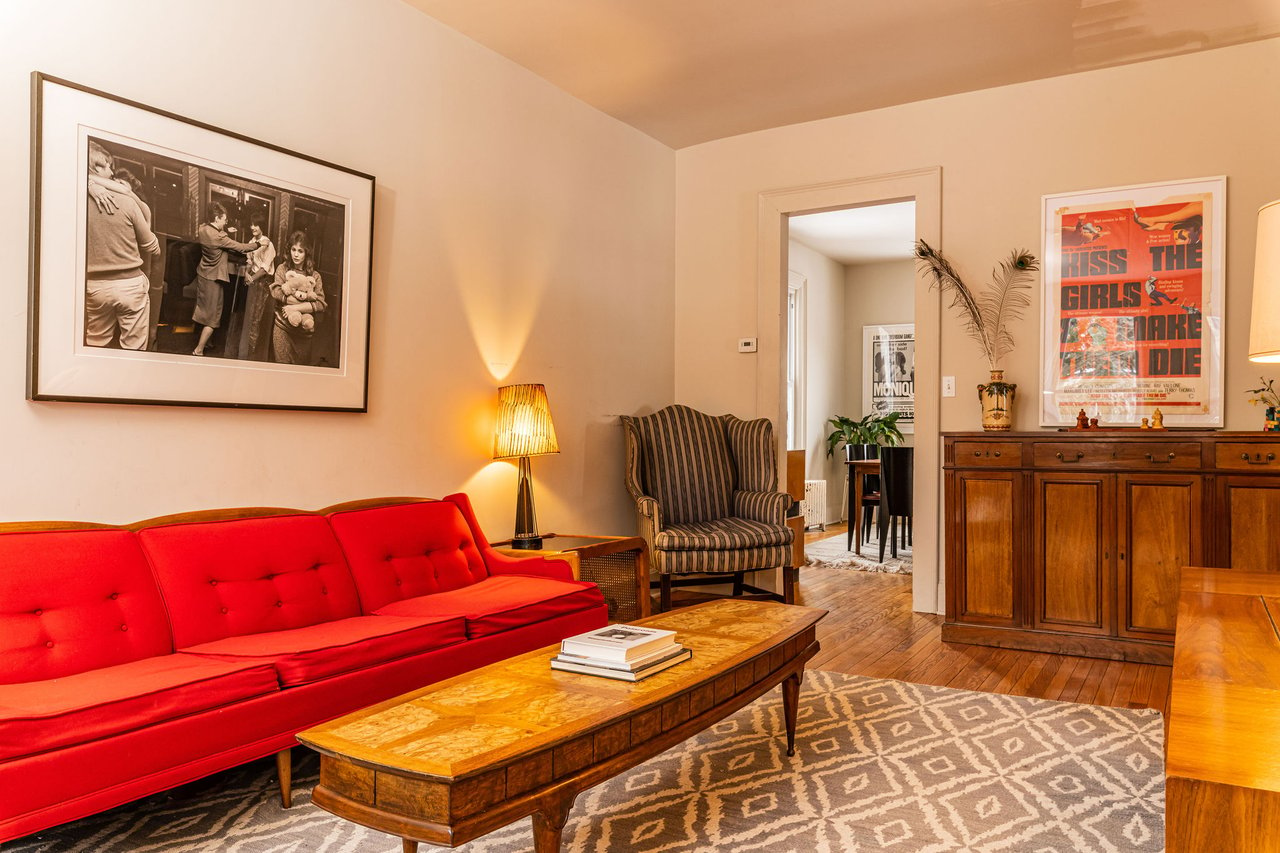
I remember being impressed by the Ansonia before we even walked inside. But it was the apartment that convinced me. The windows were enormous, filling the rooms with natural light. The herringbone oak floors were magnificent. Intricate moldings, generous ceiling heights, and beautifully proportioned rooms spoke to an entirely different era of residential architecture. The bedroom was enormous. The layout was comfortable and gracious. Although it was only a one-bedroom apartment, everything about it felt grand. I knew almost immediately that it was the one.
We were leaving behind a building with nearly every modern convenience, but the Ansonia offered something that couldn't be captured on an amenities checklist. There was a sense of permanence and craftsmanship that I found irresistible, along with a generosity of space that felt increasingly rare in New York. And that feeling extended well beyond our apartment.
A Building That Doesn't Believe in Modesty
Completed in 1904, the Ansonia was designed by architect Paul E. M. DuBoy in the French Beaux-Arts style. Originally conceived as an opulent residential hotel, it was among the most ambitious residential buildings of its time. More than a century later, that ambition is evident everywhere.
Entering the building is an experience in itself. The grand porte-cochère recalls a time when horse-drawn carriages arrived at the entrance. Inside, the ceilings soar, the staircase is magnificent, and the corridors are so wide that I've often joked you could drive a car down them. There are elaborate doors, decorative ironwork, beautiful windows, and architectural details that would be difficult to justify in a contemporary residential development.
Even collecting the mail feels like a remnant of another era. Rather than retrieving it from a wall of individual mailboxes, residents receive their mail personally from the building staff. It's a small detail, but one that feels entirely appropriate in a building that began its life as a grand residential hotel. The Ansonia was designed at a time when space and ornamentation were treated as expressions of luxury. Today, when so much residential design is concerned with efficiency and maximizing usable square footage, the scale of its common spaces feels almost extravagant. And then there's its history.
A History That Could Only Happen in New York
The Ansonia has accumulated more than its fair share of extraordinary stories. Its original developer, William Earle Dodge Stokes, was eccentric enough to establish a rooftop farm, complete with chickens, ducks, and goats. The idea was to provide fresh food for residents, although the arrangement eventually ran afoul of the city's health authorities.
Over the years, the building attracted a remarkable collection of musicians, performers, athletes, and artists. Enrico Caruso, Igor Stravinsky, Arturo Toscanini, Gustav Mahler, and Sergei Rachmaninoff all called the Ansonia home. Its other notable residents included Broadway impresario Florenz Ziegfeld, heavyweight boxing champion Jack Dempsey, baseball legend Babe Ruth, and, more recently, actors Christopher Lloyd and Angelina Jolie.
It's an almost absurd collection of personalities to have shared a single address. I love imagining some of the greatest musicians of the twentieth century walking through the same corridors we use today. And there's something particularly fitting about the building's musical heritage given its proximity to Lincoln Center.
The building's history isn't entirely genteel, either. Its basement once housed the Continental Baths, an important gathering place in New York's cultural history, where Bette Midler and Barry Manilow performed early in their careers. The space later became Plato's Retreat, the notorious swingers' club. It's difficult to imagine another residential building with quite such an improbable collection of chapters.
One of my favorite little details is a display dedicated to Babe Ruth, complete with a signed baseball and memorabilia commemorating his time as a resident. There's something wonderfully amusing about encountering a small shrine to one of baseball's greatest figures in the middle of your apartment building. But at the Ansonia, it somehow feels perfectly normal.
A Small City Within a City
For all its grandeur, one of the Ansonia's most appealing qualities is the extraordinary variety of people who live here. There are modest studios, enormous residences, and just about everything in between. Some residents have been here for decades, including people whose tenancy predates the building's condominium conversion. It's a remarkable cross section of New York City, with people from vastly different backgrounds sharing the same elaborate address.
And then there are the dogs. The Ansonia is wonderfully pet-friendly, and the canine residents seem to reflect the same diversity as their owners. There are tiny dogs with enormous personalities, enormous dogs with surprisingly gentle dispositions, and just about everything in between. The dogs are as much a part of the building's social life as the people.
What's remarkable is that despite its size, the Ansonia still feels like a community. Neighbors acknowledge one another. People are friendly. The staff become familiar faces. There's a warmth to the place that you might not expect from a building of this scale. It would be easy for somewhere so grand to feel imposing or impersonal. Somehow, the Ansonia manages to be neither.
Of course, living in a building that's more than 120 years old isn't without its quirks. Like many prewar buildings, the heating system occasionally seems determined to recreate a tropical climate in the middle of January. There are winter days when we have to open the windows just to keep the apartment comfortable. But that's part of the bargain. You accept a few eccentricities in exchange for things that simply cannot be recreated.
A Conversation Above the Upper West Side
One of my favorite places in the building is the roof deck. It's not particularly elaborate. The finishes and amenities aren't especially remarkable, but they don't need to be. The views are extraordinary. From up there, the Upper West Side reveals itself in a way that's difficult to appreciate from the street. The San Remo, the Beresford, the Level Club, and other architectural landmarks rise above the surrounding neighborhood, each with its own distinctive silhouette. You can look toward Central Park in one direction and the Hudson River in another.
I've always felt that these buildings are somehow in conversation with one another. From the street, you experience them individually, separated by blocks and interrupted by everything happening at ground level. From the Ansonia's roof, you can appreciate how they relate to one another. Their towers, elaborate rooflines, and architectural flourishes belong to an era when architects approached residential buildings with an extraordinary sense of ambition. Together, they give the Upper West Side much of its distinctive character.
Then you turn south, and the conversation changes entirely. Beyond the historic rooftops, you can see the unmistakable silhouette of 432 Park Avenue, the distinctive form of One57, and other towers along Billionaires' Row. Farther south and west, Midtown and Hudson Yards introduce yet another generation of skyscrapers. The contrast is striking. The elaborate masonry and ornamentation of the older buildings give way to glass, steel, and the extraordinary height of contemporary Manhattan. I don't necessarily see one as better than the other. They're expressions of different eras, different technologies, and different ideas about how a city should look and function.
What makes the view so special is being able to appreciate both at once. From a single rooftop, you can trace more than a century of New York's architectural evolution. It's a perspective I never tire of, and one of the things that makes living here so special.
The New York I Love, Right Outside the Door
As much as I love the building itself, the surrounding neighborhood has become just as important to me. One of the great pleasures of living on this stretch of the Upper West Side is the remarkable mix of institutions, restaurants, cultural destinations, and everyday neighborhood life.
Zabar's, Barney Greengrass, and Gray's Papaya are all part of the area's identity. These aren't necessarily the newest or most fashionable places in town, and that's precisely the point. They're establishments that have endured, much like the Ansonia itself. The neighborhood also offers an extraordinary range of restaurants, from sophisticated dining rooms to inexpensive little places that become part of your weekly routine.
One of my favorites is the café on the second floor of Fairway. There's something quintessentially New York about sitting above a grocery store, enjoying a reasonably priced meal while looking out over Broadway, surrounded by people from every walk of life. It isn't glamorous, and that's exactly why I love it. There's room for both experiences here. An elegant dinner one evening, a completely unpretentious meal the next. Both feel equally authentic.
Getting around the city is remarkably easy. The 1, 2, and 3 subway lines provide quick access downtown, while the buses make traveling across town convenient. I can be in Greenwich Village in roughly ten minutes on the express subway, and I often head farther into the West Village for restaurants and a different atmosphere. I also spend a surprising amount of time on the Upper East Side, where I do much of my shopping.
That's one of the things I appreciate most about living here. I get to enjoy the established, residential character of the Upper West Side without feeling confined to it. Some of my favorite parts of Manhattan are only a short subway ride or crosstown trip away. Central Park and Riverside Park are both within walking distance, offering two entirely different versions of outdoor life in Manhattan.
And then there's the culture. Lincoln Center is just a handful of blocks away, putting the Metropolitan Opera, New York Philharmonic, and New York City Ballet practically in our backyard. Broadway's theaters are a short subway ride away. The American Museum of Natural History and the New York Historical Society are also part of our neighborhood. And the Beacon Theatre, a beautifully preserved performing arts venue featuring some of the world's greatest musicians and performers, is directly across the street. For someone who loves New York's cultural life, it's difficult to imagine a more convenient place to live.
There's something particularly fitting about being so close to Lincoln Center while living in a building that has housed some of the great musicians and performers of the past century. We moved here because we fell in love with an apartment. We've stayed because we fell in love with everything that surrounds it.
Growing Up at the Ansonia
When our son was born, our relationship with the building changed again. The wonderful one-bedroom that had served us so well was no longer quite enough. We needed more space and a layout better suited to family life. But we weren't particularly interested in leaving the Ansonia.
Instead, we moved into a larger two-bedroom apartment within the building. The new apartment has accommodated our lives much better, and the architectural charm that attracted us in the first place is still there. Of course, we made compromises. Our new kitchen is smaller, and we gave up the spacious eat-in kitchen we'd enjoyed in our previous apartment.
That's the reality of Manhattan real estate. Even when you move into a larger home, you don't necessarily get more of everything. We gained the space and flexibility our family needed, and we were able to remain in a building we had come to love.
One of the unexpected gifts of raising our son at the Ansonia was having a school right inside the building. For a time, the morning school run didn't require going outside at all. No wrestling with winter coats and boots, no umbrellas on rainy mornings, no complicated logistics. We could simply take the elevator downstairs, drop him off, and return home. It was an almost absurdly convenient arrangement, especially by New York City standards. As he's grown, we've moved him to another school on the Upper West Side that we feel is a better fit for the next stage of his education.
But raising him here has also made us appreciate the neighborhood in an entirely different way. The museums, parks, music, theater, architecture, and extraordinary variety of people are all part of the world immediately around him. He's growing up in a place where art, history, and culture aren't distant attractions requiring elaborate planning. They're woven into everyday life. These aren't things we need to introduce him to on a special trip to New York. They're simply part of his childhood.
I sometimes think that raising our son at the Ansonia is one of the greatest gifts we've been able to give him. Not because of the building's grandeur or famous history, but because of the extraordinary city that exists just outside its doors.
What Makes a Home Special
Living at the Ansonia has inevitably influenced the way I think about real estate. As an agent, I spend a great deal of time looking at properties, evaluating layouts, considering finishes, and thinking about what makes a home desirable. But living here has reinforced something that isn't always easy to communicate through photographs, floor plans, or a listing description. There's a difference between square footage and the feeling of space. Between expensive finishes and genuine craftsmanship. Between a building with an impressive list of amenities and one that offers a real sense of place.
The Ansonia isn't perfect. No building is. And I wouldn't suggest that everyone would appreciate its peculiarities in quite the same way I do. But that's part of what makes New York real estate so interesting. Different buildings offer entirely different ways of living, and finding the right home involves understanding which qualities matter most to you.
A decade after first walking through the doors of the Ansonia, I still find myself looking up at its ornamental facade as I approach along Broadway. It still impresses me, and it still feels a little improbable that a building like this exists in the middle of New York City.
But what I love most about the Ansonia has changed. In 2016, I fell in love with an apartment. Today, I love the life we've built inside the building, the people who share it with us, and the city our son gets to experience every day. I suppose that's what makes a home truly special. Not just the place itself, but everything that happens because you live there.